
[Checklist] Launching a Quantum Digital Twin
External Source means this preview stays on Qubicweb while the full article lives on the publisher site.
Brief points
Key points will appear here after this read is condensed for Qubicweb. Use the source link below if you need the full article immediately.
How entangled decision substrates will replace classical multi-agent heuristics. A breakdown of Level 4 maturity.
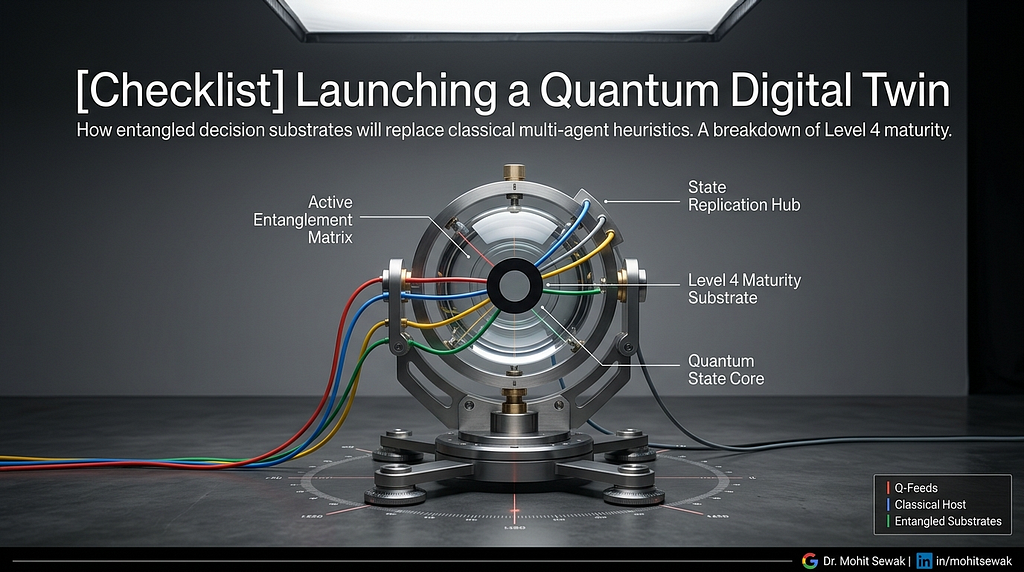
A physical studio installation representing the structural blueprint of a Level 4 Quantum Digital Twin, where entangled decision substrates converge into a central optical state engine.
For decades, the standard playbook of high-stakes enterprise research and development has resembled an expensive, slow-motion game of chemical roulette. You design a candidate molecule, queue up for a supercomputer simulation, and wait several hours only to receive a passive, heuristic approximation. This classical bottleneck is not merely an engineering inconvenience; it is a quiet financial black hole that stifles breakthrough innovation across materials science, pharmaceutical development, and complex logistics. If we sat down over a hot cup of masala tea to discuss why your digital twins are currently failing, this is the exact pain point I would sketch out on a napkin. But what if you could compress this entire multidimensional optimization process into the time it takes to brew that single cup?
📊 Executive Summary: Deploying active Quantum Digital Twins (QDTs) requires transitioning from passive models to hybrid quantum-agentic architectures. Driven by Microsoft’s June 2026 Majorana 2 topological breakthrough, which achieved a 1,000-fold reliability improvement and stabilized qubit lifetimes to 20 seconds, the commercial quantum threshold has compressed to 2029 (Nayak, 2026). By implementing the formal $(\mathcal{Q}, \mathcal{C}, \mathcal{M}, \mathcal{P}, \mathcal{A})$ tuple via middleware, enterprises can compress legacy $30,000 simulation workflows to a 30-second, $25 operation (Haiqu, 2026).
I. The $25 Disruption: Why the 2029 Quantum Horizon Demands Agentic Digital Twins Today
The traditional approach to simulating complex physical systems has reached a hard mathematical ceiling. When evaluating highly correlated molecular states, classical computers must resort to crude approximations because calculating the exact quantum mechanics of just a few dozen atoms requires more bits than there are atoms in the observable universe. This translates to an immense economic tax; a complex molecular dynamics simulation that historically cost $30,000 in raw high-performance computing (HPC) cloud credits and took nine hours of execution can now be optimized, compiled, and executed in just 30 seconds for roughly $25 (Haiqu, 2026). This massive financial and temporal compression is not the result of incremental hardware speedups, but of a fundamental paradigm shift in how we orchestrate quantum workflows.
🔍 Fact Check: According to benchmarks from Haiqu (2026), full-stack quantum middleware compresses a complex molecular dynamics simulation from a $30,000, nine-hour classical supercomputing run down to a $25 operation executed in just 30 seconds (Haiqu, 2026).
This shift is driven by the rise of “Agentic Quantum” systems — a bidirectional synergy where autonomous AI agents do not merely act as passive interfaces, but actively orchestrate, compile, and debug quantum states (Kipu Quantum, 2025). Think of self-attention in a transformer like the cocktail party effect, filtering out background noise to focus on a single voice; in the same way, quantum agents filter through noisy physical qubits to construct clean, logical circuits (Kipu Quantum, 2025; Quantum Metric, 2026). Rather than requiring human quantum physicists to manually write pulse-level code, these autonomous agents perceive the state of the quantum processor, dynamically generate variational circuits, and correct errors in real-time (Kipu Quantum, 2025; Lee, 2026). This active orchestration transforms quantum computing from a highly specialized, fragile laboratory tool into a robust, hands-free enterprise utility (Lee, 2026).
┌─────────────────────────────────────────────────────────┐
 │ AGENTIC CONTROL LOOP │
 │ Autonomous AI Agent perceives environment & goal │
 └────────────────────────────┬────────────────────────────┘
 │
 [Translates Intent to Circuit]
 ▼
 ┌─────────────────────────────────────────────────────────┐
 │ MIDDLEWARE & COMPRESSION │
 │ Haiqu OS / SuperQuantX compresses & mitigates noise │
 └────────────────────────────┬────────────────────────────┘
 │
 [Deploys Noise-Resilient Gates]
 ▼
 ┌─────────────────────────────────────────────────────────┐
 │ PHYSICAL QUANTUM HARDWARE │
 │ Topological QPUs (e.g., Majorana 2) execute state │
 └─────────────────────────────────────────────────────────┘
The physical timeline for this transition has accelerated dramatically due to historic breakthroughs in hardware stability. At the Microsoft Build conference in June 2026, researchers unveiled the Majorana 2 topological quantum chip, showcasing a monumental 1,000-fold reliability improvement over its predecessor (Nayak, 2026; Aghaee et al., 2026). By utilizing a next-generation materials stack featuring lead shielding to block cosmic disturbances and an active Indium Arsenide region, the chip pushed mean qubit lifetimes from milliseconds to a stable 20 seconds, with some instances surviving for up to a minute (Aghaee et al., 2026). This sudden stabilization has effectively halved the commercial quantum roadmap, placing the target for scalable, utility-class quantum computers firmly at 2029 (Nayak, 2026). Consequently, building passive digital twins that rely on classical approximations is no longer a viable long-term strategy; the transition to active Quantum Digital Twins (QDTs) is an immediate enterprise mandate.
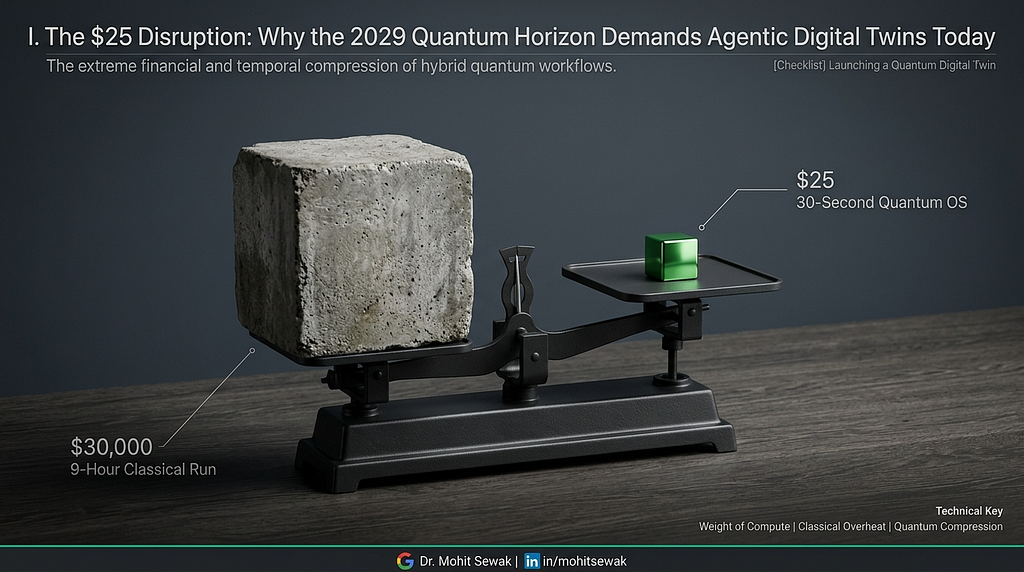
A physical balance scale model illustrating the monumental economic shift: a giant concrete monolith representing $30,000 classical runs is offset by a tiny, high-efficiency green quantum block representing a $25 operation.
II. The Silent Toll of the Status Quo: The Classical Simulation Bottleneck
Relying on classical reinforcement learning and multi-agent systems to manage high-stakes operations is akin to navigating a complex maze with a flashlight that only illuminates two inches ahead. When classical agents are tasked with executing complex logistics scheduling, high-dimensional search, or molecular optimization, they inevitably fall victim to the combinatorial explosion (Kipu Quantum, 2025; Armbrüster, 2026). As the number of variables, constraints, or physical components increases linearly, the possible state configurations grow exponentially, causing classical neural networks to choke under the computational weight. To bypass this, classical systems rely on heuristic shortcuts that sacrifice fidelity, leaving millions of dollars in optimization efficiency on the table (Kipu Quantum, 2025).
Beyond the sheer computational strain, classical deep learning architectures suffer from a more insidious vulnerability: they are fundamentally incapable of true causal reasoning. Traditional models excel at identifying correlations within historical datasets, but they lack mechanistic grounding, intervention logic, and deterministic safety boundaries (Lee, 2026). This limitation often leads to hallucinated optimization parameters that violate basic physical or biological constraints (Lee, 2026). In high-stakes domains like computational biology or industrial manufacturing, these hallucinations are not just minor bugs; they represent catastrophic risks that can derail clinical trials or cause physical hardware failures on the factory floor (Lee, 2026).
┌─────────────────────────┐
 │ CLASSICAL SIMULATION │
 │ Heuristics & Chaos │
 └────────────┬────────────┘
 │
 [Combinatorial Explosion / Noise]
 ▼
 ┌─────────────────────────┐
 │ HALOED CORRELATIONS │
 │ Unsafe Hallucinations │
 └────────────┬────────────┘
 │
 [Wasted Compute & Failure]
 ▼
 ┌─────────────────────────┐
 │ QUANTUM DIGITAL TWIN │
 │ Causal Safety & Speed │
 └─────────────────────────┘
Every month an enterprise spends clinging to these legacy simulation frameworks represents a massive waste of both compute budget and R&D velocity. Passive digital twins merely act as glorifed dashboards, visualising what has already occurred rather than dynamically navigating future states. To build a true competitive moat, modern operations require a Quantum Digital Twin: a live, high-fidelity physical-state model built from live data streams and powered by hybrid quantum-classical simulation (Mindverse Computing, 2026). By deploying the following structured, phase-by-phase blueprint, COOs and technology leaders can systematically transition their organizations into the quantum-agentic era.
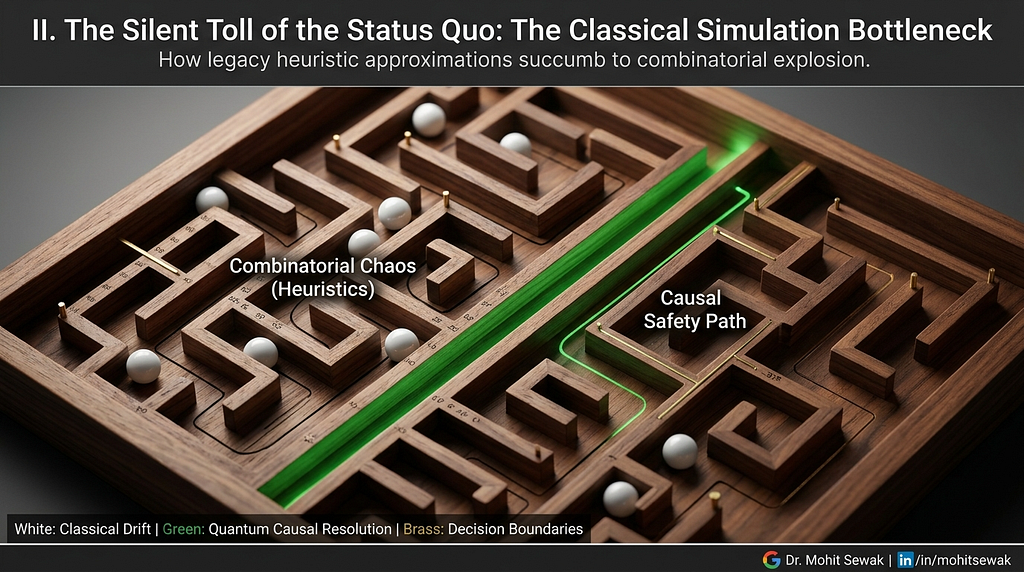
A physical wooden maze demonstrates the classical simulation bottleneck where heuristic paths scatter into chaos, contrasted by a single structured green quantum causal pathway.
“Classical limits compute correlations; quantum agents orchestrate causality.” — Mohit Sewak, Ph.D.
III. Phase 1: Architectural Blueprinting (Defining the Mathematical Q-Agent Tuple)
The transition from a passive classical twin to an active Quantum Digital Twin begins with establishing a rigorous mathematical and structural foundation. We must move away from ad-hoc software scripting and embrace the formal conceptual architecture of a Quantum Agent (Sultanow et al., 2026). This framework ensures that quantum processing resources are not merely treated as external calculators, but are structurally integrated directly into the agent’s perception-decision-action loop (Sultanow et al., 2026).
┌────────────────────────────────────────────────────────┐
 │ PERCEPTION (𝒫) │
 │ Ingests real-time multi-modal environmental data │
 └───────────────────────────┬────────────────────────────┘
 │
 ▼
 ┌────────────────────────────────────────────────────────┐
 │ HYBRID MEMORY (ℳ) │
 │ Maintains classical state & quantum density matrices │
 └───────────────────────────┬────────────────────────────┘
 │
 ▼
 ┌────────────────────────────────────────────────────────┐
 │ CLASSICAL CONTROL (𝒞) │
 │ Orchestrates queries & manages hardware resources │
 └───────────────────────────┬────────────────────────────┘
 │
 ▼
 ┌────────────────────────────────────────────────────────┐
 │ QUANTUM RESOURCES (𝒬) │
 │ Executes high-dimensional superposition solvers │
 └───────────────────────────┬────────────────────────────┘
 │
 ▼
 ┌────────────────────────────────────────────────────────┐
 │ ACTION (𝒜) │
 │ Deploys real-world outputs & QPU control overrides │
 └────────────────────────────────────────────────────────┘
To achieve this integration, the system must be modeled mathematically as the formal tuple:
$\mathcal{T} = (\mathcal{Q}, \mathcal{C}, \mathcal{M}, \mathcal{P}, \mathcal{A})$
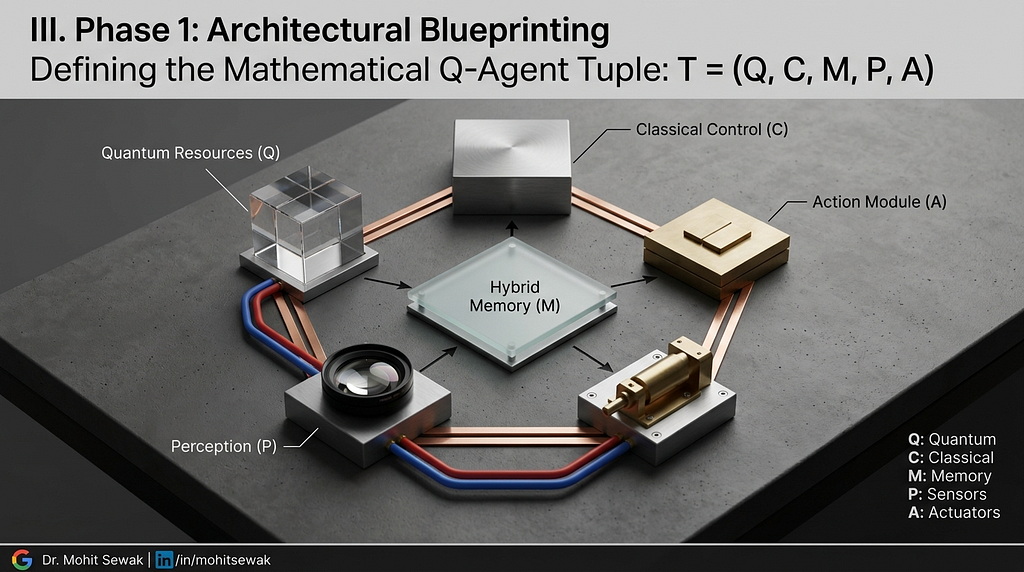
A tactile physical desktop installation representing the mathematical Q-Agent tuple, showing the modular routing from sensor perception to quantum solver states.
This tuple defines a closed-loop cognitive architecture where each component serves a distinct, non-classical role (Sultanow et al., 2026):
- $\mathcal{Q}$ (Quantum Resources): This component represents the physical QPUs, topological quantum chips, or tensor-network-based simulators, alongside the assembly circuits used to manipulate their quantum states (Sultanow et al., 2026).
- $\mathcal{C}$ (Classical Control): This is the classical control logic that governs the execution of $\mathcal{Q}$, interpreting probabilistic quantum measurements and managing resource allocation (Sultanow et al., 2026).
- $\mathcal{M}$ (Hybrid Memory): A specialized memory subsystem designed to handle classical variables alongside quantum density matrices while strictly adhering to the no-cloning theorem, which prevents the direct duplication of arbitrary quantum states (Sultanow et al., 2026).
- $\mathcal{P}$ (Perception Module): The system’s sensory apparatus, responsible for ingesting multi-modal real-time data streams from physical sensors, IoT devices, or industrial telemetry (Sultanow et al., 2026).
- $\mathcal{A}$ (Action Module): The execution engine that maps optimized decisions back to the physical environment, deploying control signals or mechanical overrides (Sultanow et al., 2026).
To scale this architecture effectively, organizations must map their development lifecycle against a validated maturity model. At Level 1 (NISQ-Optimized), the agent uses noise-resilient techniques to run basic algorithms on current noisy hardware (Sultanow et al., 2026). Moving to Level 2 (Hybrid QML Policy), the agent incorporates parameterized quantum machine learning circuits to guide its internal policy decisions (Sultanow et al., 2026). By the time the organization reaches Level 3 (Domain-Aware) and Level 4 (Fully Quantum-Native), the agent operates natively within a fault-tolerant, large-scale quantum ecosystem, leveraging entangled states to evaluate entire operational solutions simultaneously (Sultanow et al., 2026).
📋 Phase 1: Launch Checklist
- Map the Tuple Components ($\mathcal{Q}, \mathcal{C}, \mathcal{M}, \mathcal{P}, \mathcal{A}$): Allocate dedicated classical processing clusters to manage the control logic ($\mathcal{C}$) and sensor perception ($\mathcal{P}$), while isolating quantum-safe memory structures ($\mathcal{M}$) that prevent illegal copying of quantum states during live synchronization.
- Define the Operational Mode: Select between Quantum-Assisted Agency (where the QPU acts as a co-processor for heavy math) and Hybrid Control/Shared Agency (where classical and quantum layers operate in a continuous, bidirectional feedback loop).
- Audit Platform Maturity: Evaluate your current developer stack to establish if you are operating at Level 1 (NISQ-Resilient) or ready to integrate Level 2 (QML Policy) models, and document the architectural migration path toward a Level 4 Quantum-Native ecosystem.
IV. Phase 2: Middleware & Orchestration Integration (Implementing Agentic Quantum OS)
In the early days of personal computing, software engineers had to write assembly instructions directly to the silicon; trying to operate a modern quantum computer without middleware presents a similarly painful bottleneck. Direct-to-hardware coding is a dead end for enterprise digital twins because Noisy Intermediate-Scale Quantum (NISQ) devices are incredibly fragile (Haiqu, 2026). To bridge the gap between high-level operational workflows and execution-ready, noise-resilient quantum circuits, organizations must deploy an Agentic Quantum Operating System (Haiqu, 2026).
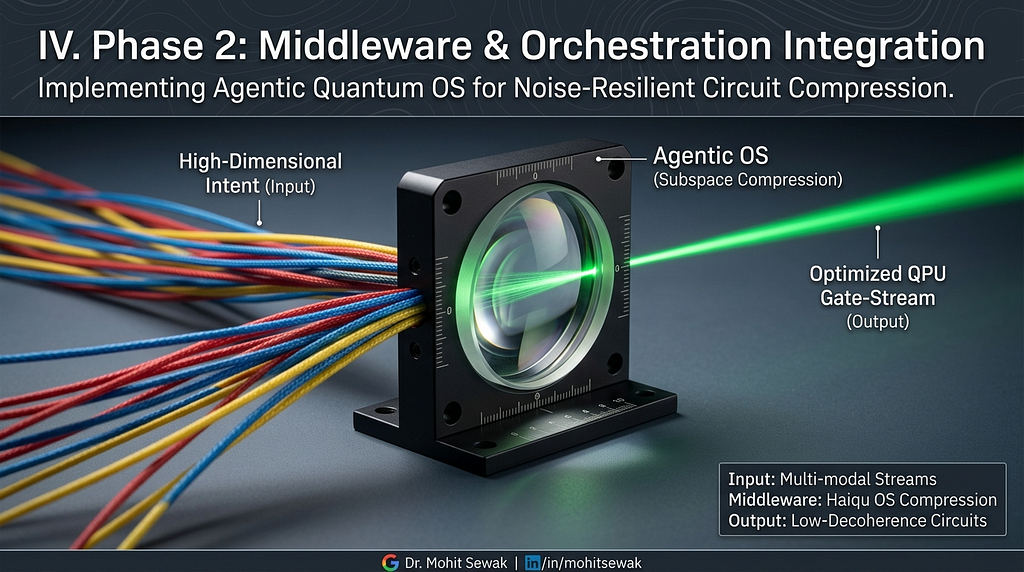
A physical optical installation visualizing the Agentic OS middleware compressing high-dimensional user intent into highly optimized, noise-resilient quantum circuits.
This middleware layer serves as an intelligent translator, allowing researchers and operators to express complex physical or mathematical intents in natural language. The Agentic OS then automatically compiles these intents into optimal, hardware-specific quantum circuits (Haiqu, 2026). This compilation process is heavily enhanced by a proprietary “compression stack” that reduces the dimension of mathematical subspaces during classical post-processing (Haiqu, 2026). By shrinking the required circuit depth, the middleware enables physical QPUs to perform up to 100x more operations before the fragile quantum states dissolve into environmental noise (Haiqu, 2026).
┌─────────────────────────────────────────────────────────────────┐
│ USER INTENT (Natural Language) │
│ "Optimize the Dioxane magnetic spectrum" │
└────────────────────────────────┬────────────────────────────────┘
 │
 ▼
┌─────────────────────────────────────────────────────────────────┐
│ AGENTIC QUANTUM OS │
│ Translates intent, designs circuit, and applies error │
│ mitigation & subspace dimension compression techniques │
└────────────────────────────────┬────────────────────────────────┘
 │
 ▼
┌─────────────────────────────────────────────────────────────────┐
│ DYNAMIC RUNTIME ORCHESTRATOR │
│ Routes tasks across classical HPC and physical QPUs │
└──────┬─────────────────────────┬─────────────────────────┬──────┘
 │ │ │
 ▼ ▼ ▼
 ┌─────────┐ ┌─────────┐ ┌─────────┐
 │ IBM │ │ IonQ │ │ QuEra │
 └─────────┘ └─────────┘ └─────────┘
Furthermore, your middleware must act as a multi-platform runtime orchestration engine. Rather than locking your enterprise into a single hardware provider, platforms like SuperQuantX provide a unified API that standardizes operations across major Quantum Machine Learning (QML) SDKs (Jagtap, 2025). Similarly, Kipu Quantum’s PLANQK platform utilizes an Agentic Quantum Computing (AQC) framework that pairs classical generative AI models with quantum-advantage algorithms (Kipu Quantum, 2025). This allows the runtime engine to dynamically coordinate resources, routing specific mathematical workloads to the hardware best suited for the task — whether that is an IBM superconducting system, an IonQ trapped-ion processor, or a QuEra neutral-atom array.
💡 ProTip: Never route raw, uncompressed continuous telemetry directly to a quantum compiler. Use a classical variational autoencoder to compress environmental sensor data into discrete latent variables first to protect fragile physical qubits from premature decoherence.
📋 Phase 2: Launch Checklist
- Deploy the Agentic SDK Layer: Configure middleware APIs (e.g., Haiqu SDK, SuperQuantX) to abstract the underlying quantum hardware, ensuring your development team can write code that runs seamlessly across different QML libraries.
- Implement Circuit Compression: Enforce active error mitigation and subspace dimension reduction techniques within your compilation pipeline to maximize the gate depth of your target NISQ devices and prevent premature decoherence.
- Establish Dynamic Runtime Orchestration: Set up an automated runtime routing engine that monitors cloud-QPU queue times, execution costs, and hardware noise profiles, dynamically dispatching files to the most efficient provider in real-time.
V. Phase 3: Engine Construction & Causal Safety (Constructing the Causal AI and Physics Core)
When building a digital twin of a nuclear reactor, a pharmaceutical molecule, or a global supply chain, there is zero margin for error. If a classical generative AI model hallucinates a marketing slogan, the consequences are trivial; if a digital twin hallucinates the thermodynamic properties of a new material, the physical consequences can be catastrophic. To prevent these failures, the core simulation engine of your Quantum Digital Twin must be built upon a foundation of causal safety and physics-informed constraints.
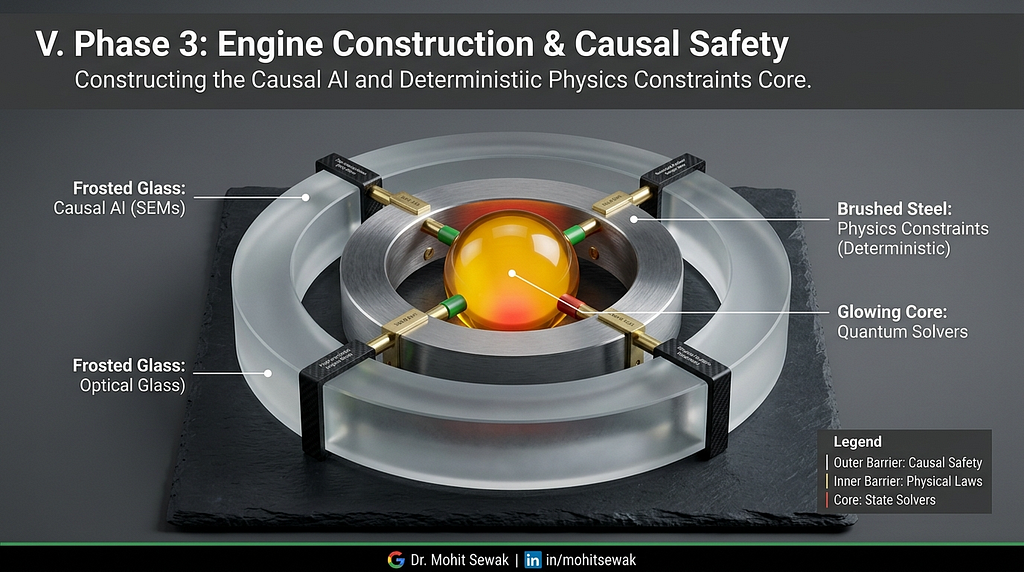
An architectural safety model illustrating the layered Causal AI and Physics Constraints framework protecting the core quantum solver from optimization hallucinations.
To achieve this, we look to the Unified Agentic-Quantum-Physics-Causal AI Framework (Lee, 2026). This architecture replaces standard, correlation-based machine learning with rigorous causal reasoning structures:
┌─────────────────────────────────┐
 │ PREDICTIVE AI │
 │ Multimodal Data Ingestion │
 └────────────────┬────────────────┘
 │
 ▼
 ┌─────────────────────────────────┐
 │ CAUSAL AI │
 │ SEMs / Counterfactual Loops │
 └────────────────┬────────────────┘
 │
 ▼
 ┌─────────────────────────────────┐
 │ PHYSICS CONSTRAINTS │
 │ Deterministic Boundary Gates │
 └────────────────┬────────────────┘
 │
 ▼
 ┌─────────────────────────────────┐
 │ QUANTUM SOLVERS │
 │ Superposition State Evaluation │
 └─────────────────────────────────┘
This framework operates as a structured hierarchy of safety and reasoning. It utilizes Structural Equation Modeling (SEMs) and Causal Random Forests to map out true counterfactual relationships, allowing the agent to evaluate what would happen under hypothetical scenarios without risking physical damage (Lee, 2026). These causal pathways are further bounded by deterministic constraint gates — hardcoded physical, biological, or thermodynamic laws that the agent’s optimization algorithms are physically prevented from overriding (Lee, 2026).
To ground this theoretical framework in operational reality, enterprises can leverage specialized, domain-specific digital twin engines. Mindverse Computing, for example, provides dedicated platforms tailored to distinct operational environments (Mindverse Computing, 2026). Whether you are using Quantum Virtual Matter (QVMa) for materials science, Quantum Virtual Omics (QVO) for genomics, or Quantum Virtual Mind (QVM) for brain-computer interface telemetry, these engines use hybrid quantum-classical solvers (such as tensor networks and quantum circuit cutting) to reconstruct the exact physical state of the system, enabling the agentic layer to generate highly reliable, safety-validated recommendations (Mindverse Computing, 2026).
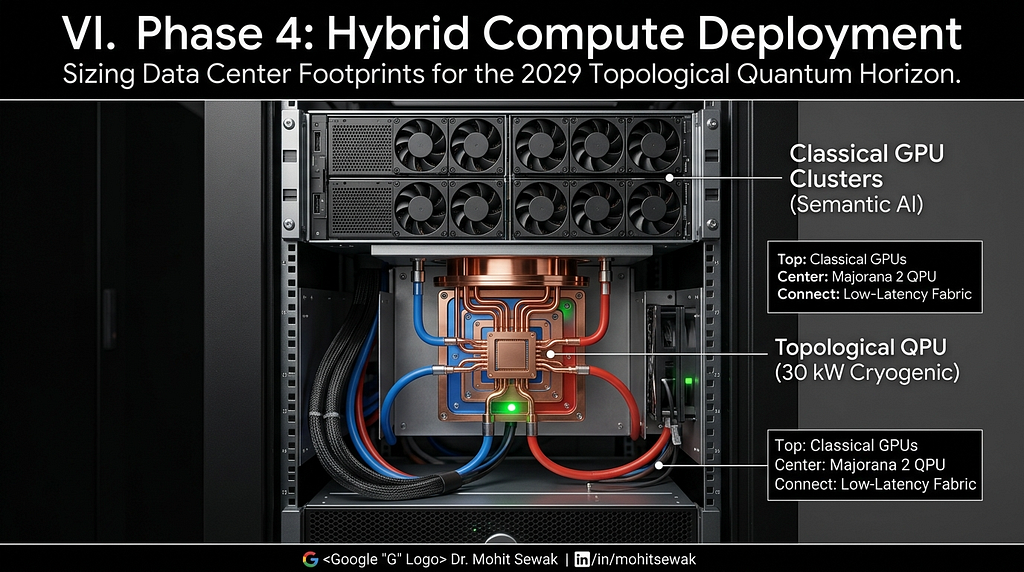
A realistic server rack deployment layout showcasing the physical co-location of heavy classical GPU clusters alongside a highly efficient 30 kW topological quantum QPU.
📋 Phase 3: Launch Checklist
- Embed the Causal Engine: Integrate Structural Equation Models (SEMs) and variational autoencoders into your agent’s decision loop to ensure it performs counterfactual analysis before proposing physical operational changes.
- Program Deterministic Constraint Gates: Implement hard-coded boundary conditions (such as conservation of energy or physiological toxicity limits) directly into the action module, ensuring the AI cannot bypass physical laws during optimization.
- Integrate Domain-Specific Quantum Solvers: Select and deploy specialized solver frameworks (such as Mindverse’s QVMa or QVO) to model complex physical phenomena like strongly correlated electron behaviors or biological genomic pathways with quantum-level accuracy.
VI. Phase 4: Hybrid Compute Deployment (Sizing Data Center Footprints for 2029)
One of the most persistent myths in enterprise technology is that quantum computers are mystical, standalone machines that must remain isolated in university physics labs. In reality, modern quantum processors are designed to slide directly into standard server racks inside enterprise data centers, positioned immediately adjacent to classical high-performance computing (HPC) nodes to minimize network latency (Quartz, 2026). The physical footprint of a next-generation topological QPU is surprisingly compact, drawing roughly 30 kilowatts of power — most of which is consumed by the helium-based dilution refrigerator that cools the active core to a fraction of a degree above absolute zero (Quartz, 2026).
🔍 Fact Check: While classical AI superclusters require megawatts of power, Microsoft’s topological QPU fits within a standard server rack and draws only 30 kilowatts — over 90% of which is used to cryogenically cool a soda-can-sized active core to near absolute zero (Quartz, 2026).
ENTERPRISE HYBRID DATA CENTER
 ┌────────────────────────────────────────────────────────┐
 │ CLASSICAL GPU CLUSTERS │
 │ Generative AI, Agent Logic, Multi-modal Ingestion │
 └───────────────────────────┬────────────────────────────┘
 │
 [Azure Quantum CLI]
 ▼
 ┌────────────────────────────────────────────────────────┐
 │ TOPOLOGICAL QUANTUM QPU RACK │
 │ - Standard Server Rack Footprint │
 │ - 30 kW Power Capacity │
 │ - Helium-based Dilution Refrigerator (Cryogenic) │
 │ - Low-Latency Interconnect │
 └────────────────────────────────────────────────────────┘
However, planning for a 2029 deployment requires balancing the immense energy demands of agentic AI systems against the highly efficient, pinpoint nature of quantum computing. Large language models and supervisor agents are incredibly power-hungry, requiring massive GPU clusters to process semantic workloads (Quartz, 2026). To optimize this energy profile, your deployment architecture must divide and conquer. The classical GPU clusters should handle semantic search, real-time data ingestion, and general agentic reasoning, while the physical QPU is reserved strictly for high-value, multidimensional optimization tasks (Quartz, 2026).
To implement this division of labor, the agentic workflow must automatically translate complex physical coordination or resource allocation tasks into Quadratic Unconstrained Binary Optimization (QUBO) or Quantum Approximate Optimization Algorithm (QAOA) tasks (agenticsorg, 2026). Using tools like the Azure Quantum CLI, the classical supervisor agent compiles these high-dimensional math problems and dispatches them to the QPU (agenticsorg, 2026). The quantum hardware solves the optimization challenge in seconds, returning a clean, deterministic result to the classical agent, thereby saving megawatts of power that would have otherwise been wasted on brute-force classical simulations (agenticsorg, 2026).
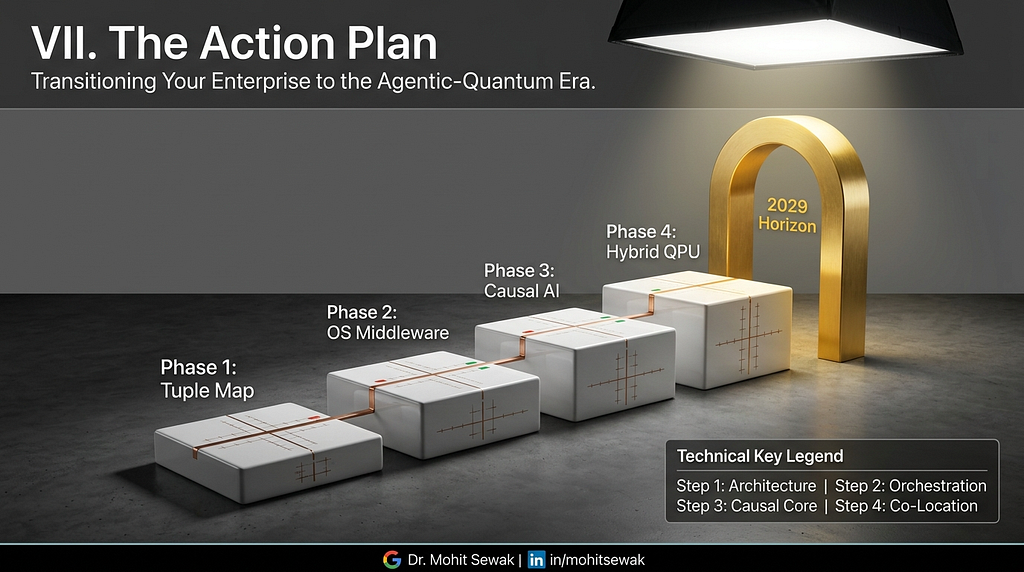
A physical sequential milestone model mapping out the concrete, phase-by-phase operational roadmap required to scale a Quantum Digital Twin by the 2029 commercial horizon.
📋 Phase 4: Launch Checklist
- Formulate Optimization Workloads (QUBO/QAOA): Standardize your scheduling, logistics, and resource allocation problems into Quadratic Unconstrained Binary Optimization (QUBO) mathematical formats that can be parsed by quantum annealing engines.
- Provision Hybrid Cloud-QPU Access: Set up your agentic orchestration pipeline to dynamically interface with cloud-based quantum environments (such as Azure Quantum or AWS Braket) to balance localized classical LLM processing with remote QPU calculations.
- Plan Physical Co-Location (Enterprise Readiness): If building an on-premises deployment for the 2029 horizon, verify that your data center facility can support a standard server rack equipped with 30 kW power distribution and cryogenic liquid handling infrastructure.
VII. The Action Plan: Transitioning Your Enterprise to the Agentic-Quantum Era
The convergence of autonomous AI agents and topological quantum mechanics is not a science fiction project slated for the mid-2030s; it is the definitive technological battleground of the current decade. With Microsoft’s Majorana 2 chip compressing the timeline for utility-scale quantum systems to 2029, the window of opportunity for enterprises to establish their quantum architectures is closing rapidly (Nayak, 2026). The organizations that begin blueprinting their quantum agents and integrating middleware platforms today will build an insurmountable computational moat long before the rest of the market realizes the classical paradigm has ended.
Your path forward begins with a commitment to execution this quarter. Do not wait for fault-tolerant hardware to become universally available; start by modeling your operations through the lens of the $(\mathcal{Q}, \mathcal{C}, \mathcal{M}, \mathcal{P}, \mathcal{A})$ tuple using current classical simulators and NISQ-optimized middleware (Sultanow et al., 2026; Haiqu, 2026). To accelerate this transition, we have prepared a comprehensive developer kit designed to help your technical team implement their first quantum-agentic loop.
📥 Download the Enterprise Resource
Ready to take the first step toward the 2029 quantum horizon? Download our complete implementation package: “The Enterprise Q-Agent Configuration Blueprint & Code Template.” This resource includes production-ready Python templates for mapping your live data streams to the formal $(\mathcal{Q}, \mathcal{C}, \mathcal{M}, \mathcal{P}, \mathcal{A})$ tuple, alongside pre-configured YAML files for Azure Quantum CLI deployments.
References & Further Reading
Core Foundations of Quantum-Agentic Synergy
Armbrüster, U. (2026, May 15). Strengthening agentic AI with quantum computing. Atos Blog. https://atos.net/en/blog/strengthening-agentic-ai-with-quantum-computing
Armbrüster, U., Edelkamp, S., Maresch, G., & Schulze, E. (2026). Imperfect-Information Games on Quantum Computers: A Case Study in Skat. arXiv preprint arXiv:2411.15294v2. https://arxiv.org/abs/2411.15294
Sultanow, E., Tehrani, M., Dutta, S., Buchanan, W. J., & Khan, M. S. (2026). Defining Quantum Agents: Formal Foundations, Architectures, and NISQ-Era Prototypes. Quantum Reports, 8(1), 24. https://doi.org/10.3390/quantum8010024
Topological Hardware and Agentic Acceleration
Aghaee, M., Alam, Z., Andrzejczuk, M., Antipov, A., Asimakidis, T., Astafev, M., … & Nayak, C. (2026). 20 Second Parity Lifetime in an InAs–Pb Tetron Device. arXiv preprint arXiv:2605.13722. https://arxiv.org/abs/2605.13722
Nayak, C. (2026, June 2). Majorana 2 — Microsoft’s Scalable Quantum Processor With Reliable, Long-Lasting Qubits. Microsoft Azure Quantum Blog. https://cloudblogs.microsoft.com/quantum/2026/06/02/majorana-2-microsofts-scalable-quantum-processor-with-reliable-long-lasting-qubits/
Quartz. (2026, May 14). AI data centers and quantum computing are about to collide. Quartz. https://qz.com/ai-data-centers-quantum-computing-collide-1851475899
Advanced Software Middleware and SDKs
agenticsorg. (2026). Quantum Agentics: The Quantum Agent Manager. GitHub. https://github.com/agenticsorg/quantum-agentics
Haiqu. (2026, May 6). Haiqu Launches Agentic Quantum Operating System to Accelerate Enterprise R&D. Haiqu. https://haiqu.ai/insights/haiqu-launches-agentic-quantum-operating-system-for-enterprise-applications-r-d
Jagtap, S. (2025, September 12). Introducing SuperQuantX: Foundational Research for Quantum and Agentic AI. Superagentic AI Blog. https://super-agentic.ai/blog/introducing-superquantx-foundational-research-for-quantum-and-agentic-ai
Kipu Quantum. (2025, June 19). IonQ and Kipu Quantum Break New Performance Records for Protein Folding and Optimization Problems. Nasdaq. https://www.nasdaq.com/press-release/ionq-and-kipu-quantum-break-new-performance-records-for-protein-folding-and
Domain-Specific Implementations and Digital Twins
Lee, A. G. (2026, February 24). Unified Agentic-Quantum–Physics–Causal AI Framework: Next-Generation AI Paradigm for Healthcare & Life Sciences. Medium. https://medium.com/@alexglee/unified-agentic-quantum-physics-causal-ai-framework-next-generation-ai-paradigm-for-healthcare-life-sciences
Mindverse Computing. (2026). Mindverse Computing — Agentic Quantum Digital Twin Development Platform. Mindverse Computing. https://mindversecomputing.com
Quantum Metric. (2026, March 25). Quantum Metric Launches Felix Agentic, the Autonomous Digital Experience Analyst. PR Newswire. https://www.quantummetric.com/news/press-releases/quantum-metric-launches-felix-agentic-the-autonomous-digital-experience-analyst/
Disclaimer: The views and opinions expressed in this article are personal and do not necessarily reflect the official policy or position of any associated agencies, organizations, or the India AI Mission. AI assistance was utilized in the research, drafting, and ideation of this article. Licensed under CC BY-ND 4.0.
[Checklist] Launching a Quantum Digital Twin was originally published in DataDrivenInvestor on Medium, where people are continuing the conversation by highlighting and responding to this story.